A Risk Tier Is Not an Execution Clearance
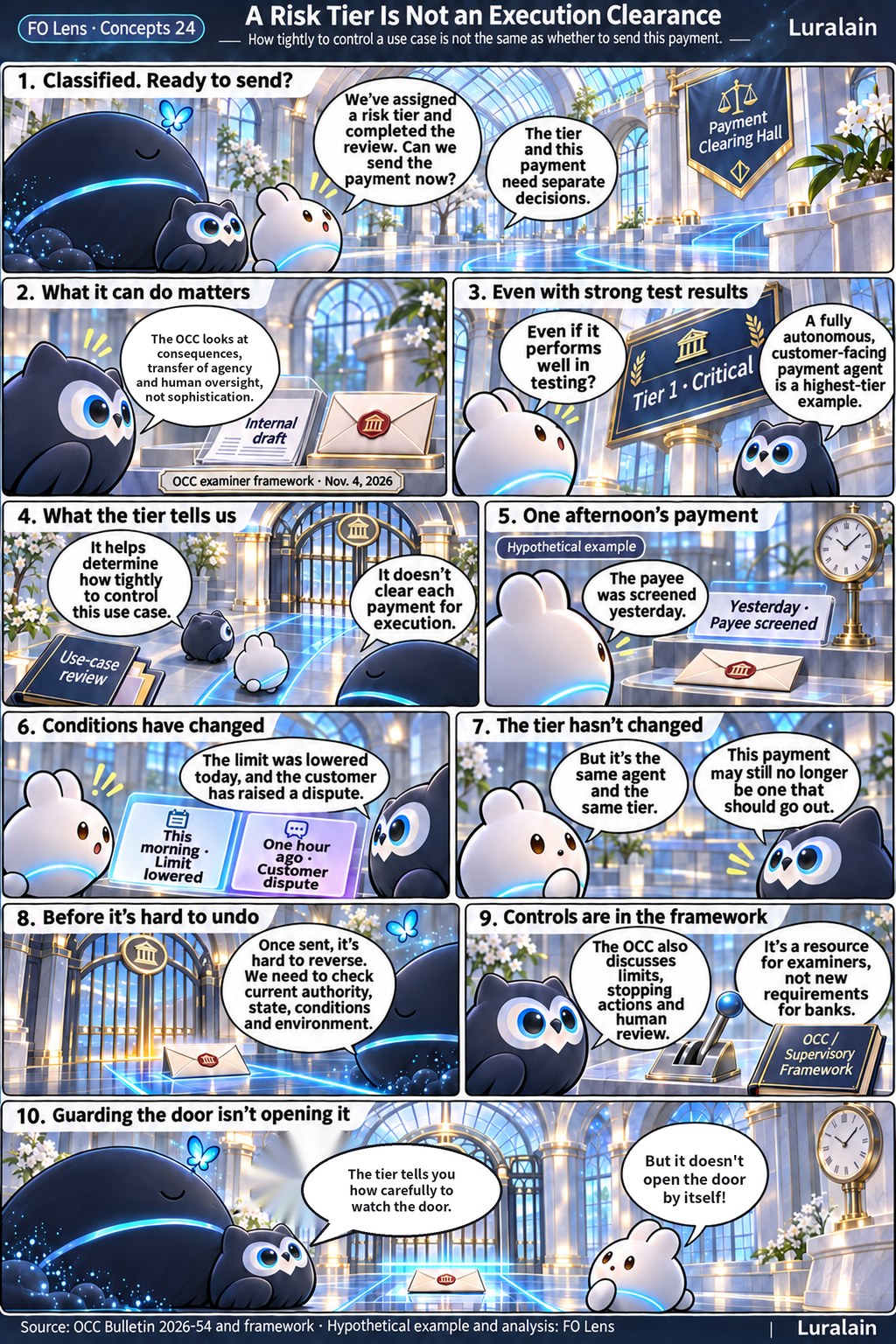
The OCC's new examiner framework classifies banks' AI use cases by consequence, transfer of agency and human oversight rather than technical sophistication, and places a fully autonomous, customer-facing payment agent in its highest tier. A tier tells a bank how heavily to control a use case. Whether a particular payment may go out is decided later, one action at a time.
On November 4, 2026, the U.S. Office of the Comptroller of the Currency issued a framework that gives its bank examiners a way to classify AI use cases by what they can do, not by how sophisticated they are: the consequences of failure, how much agency has been handed over, and how much human oversight remains. A fully autonomous, customer-facing payment agent sits in its highest tier. This piece reads one distinction that the tiering makes visible. A tier is assigned to a use case, before deployment and when the use case materially changes. Whether one of that use case’s payments may go out is decided at the moment it executes, on facts the tier was never meant to hold.
A tier answers a different question from the one at execution
A risk tier answers how much control a use case deserves. It does not answer whether a particular action inside that use case is eligible now.
The first is settled when the use case is assessed. The second has to be settled each time an action is about to execute.
What the OCC framework sets out
OCC Bulletin 2026-54, titled Super Intelligence: Supervisory Framework, is addressed to examiners. The OCC uses “super intelligence,” or SI, for the technologies previously described as artificial intelligence, following a recent executive order. The bulletin states plainly what the document is not: it does not establish supervisory expectations for banks, and it does not set enforceable standards or prescriptive requirements. Examiners are told not to treat SI as a separate risk category. Banks are not required to define a separate SI risk appetite.
The framework presents sixteen components grouped into six pillars: purpose, risk, control, oversight, resilience and assurance. Its overarching principle is that a bank’s control intensity could rise with the potential consequences of an agent’s failure or misuse. Risk classification may rest on potential consequences, transfer of agency and the degree of human oversight, rather than on technical sophistication. The framework’s own example is direct: a simple rules-based agent authorized to initiate transactions could present greater risk than a sophisticated model limited to internal drafting.
Section 3 turns this into an illustrative tiering method. Each use case is scored on decision consequence, reversibility, customer and financial impact, autonomy, data sensitivity, explainability and provenance. For reversibility, the framework’s examples of actions that are effectively irreversible once executed include a payment that has been sent. The factors combine into four composite tiers. Tier 1, “Critical,” lists an autonomous payment agent, real-time credit decisioning, fraud-hold release and market access as examples. The framework places a fully autonomous, customer-facing payment agent at Tier 1 regardless of how well it performs in testing.
On timing, the framework says a bank may assess each use case before deployment and when material changes occur, and may document a use case’s purpose and permitted actions at the same points.
The framework also describes controls that act on individual actions. Among the tools it lists for containing an agent that is operating but acting incorrectly are deterministic rules, circuit breakers, rate limits, least-privilege permissions and kill switches. For external agents interacting through bank channels, it describes identity, delegation, authentication, velocity limits, suspension and revocation calibrated to the action requested. It describes a human reviewer who has the information and authority to reject, modify, pause or halt an output or action.
What the framework establishes
The framework establishes, for examiners, that the unit of risk is what a system can do rather than how well it performs. That is the same unit this series began with in Concepts 01.
It establishes that a tier is a property of a use case. The tier is assessed in advance and revisited when the use case changes in a material way.
It also describes controls calibrated to individual actions. It describes human review before an action is executed and monitoring while it runs, but it does not prescribe a single mechanism for checking each transaction as it executes, and as a resource for examiners it is not meant to.
Where the tier stops and the payment begins
Take a use case the framework would place at Tier 1: an agent that sends payments for customers without a person approving each one. The classification points toward greater restrictions on autonomy, stronger controls and more direct human oversight.
Now take one payment on one afternoon (an illustration, not an example from the framework). The payee was screened yesterday. The customer opened a dispute an hour ago. A limit on the account was lowered this morning. None of these changes the use case. The agent, its permissions, its model and its documented purpose are the same as they were when it was classified. These changes do not, by themselves, constitute a material change to the use case as described in this illustration. Measured against the framework’s own trigger for reassessment, nothing here calls for the use case to be reclassified. The payment may still no longer be one that should go out.
That is not a gap in the framework. It is the line between two decisions. The tier is a decision about a use case, made in advance. Eligibility is a decision about one action, made at the moment the action becomes difficult to undo. The framework’s reversibility factor points at exactly that moment: once the payment is sent, it is effectively irreversible. The tier says that moment matters most. It cannot itself be the check made at that moment.
The risk sits in how a high tier can be read. A use case that has been through the heaviest review can start to feel settled, as though its actions inherit that review. The heavier the classification, the easier it becomes to treat it as clearance. The OCC already refuses one version of this reasoning: good test performance does not lower a payment agent’s tier. The same logic runs forward. A high tier does not reduce the need to check each payment as it executes.
What this reading does not claim
This reading does not claim that the OCC overlooks controls at the moment of action. The framework names velocity limits, suspension, revocation, kill switches and human reviewers with real authority to stop an action. It does not claim that banks lack such controls.
It does not read the framework as a new requirement. The OCC states that the document is a resource for examiners and sets no expectations for banks. FO Lens does not read it as requiring any particular mechanism.
It does not claim that consequence-based tiering is the wrong unit. The opposite: it is the right unit for deciding how much control a use case deserves.
Classification and execution run on different clocks
Classification appears in many forms: risk tiers, model inventories, vendor ratings, lists of critical systems. Each is decided in advance and revisited when the system changes. Each action inside it runs on facts that move faster than the classification does. An account is restricted, a counterparty’s status changes, a policy version is replaced, a person withdraws an instruction. The system has not changed, so the classification does not move. The action is no longer the same action.
This series has read neighbouring versions of the same edge. A checkpoint that governs an agent’s proposed action still has to hold when execution opens (Concepts 21). An approval records that something was allowed. It does not, on its own, establish that it may happen now (Concepts 11).
So the useful question at the door is not only “what tier is this use case?” but “do the authority, state, conditions and operating environment this payment relies on still hold, now?” The tier decides how carefully that question must be asked. It does not answer it.
The proposition
A risk tier is a decision about a use case, made before its actions run. Execution eligibility is a decision about one action, made as it runs. A framework can get the first exactly right and still leave the second to be made at the moment of execution.
A tier tells you how carefully to watch the door. It does not open the door.
Source note. This piece draws on OCC Bulletin 2026-54, Super Intelligence: Supervisory Framework (November 4, 2026), and the supervisory framework document it links to, which FO Lens read in full. The framework is a resource for OCC examiners; it does not establish supervisory expectations for banks. This piece does not describe how examiners apply it in practice and is not an independent assessment of any bank’s controls. The execution-eligibility reading is FO Lens’s.
Related
- The Unit of AI Governance Is Executable Exposure — Concepts 01: why governance is measured at what an output becomes, not at the output.
- A Governed Proposal Is Not Yet an Eligible Execution — Concepts 21: a regulator-backed checkpoint, and whether its decision still holds when execution opens.
- Approval Is Not Execution Eligibility — Concepts 11: why an approved action can stop being the action that was approved.
The essay as a webtoon
The same characters also star in a daily-life webtoon, Rurun Clocks In.