A Governed Proposal Is Not Yet an Eligible Execution
Singapore's financial regulator has finalised its AI risk management guidelines and flagged agentic AI for further work. An industry framework published earlier with MAS places checkpoints between what an agent decides and what it executes. The question that follows is whether the basis for a checkpoint's decision still holds at the moment execution opens.
What changed this week
On October 7, 2026, the Monetary Authority of Singapore issued its final Guidelines on AI Risk Management for financial institutions, following a consultation that began in November 2025. The guidelines set out supervisory expectations: institutions should maintain an inventory of their AI use, manage risk across the lifecycle, and apply controls covering areas such as data, cybersecurity, testing, human oversight, monitoring and change management. They remain accountable for AI in their services even when it is provided by a third party. MAS expects institutions to meet the expectations in Sections 3 and 4 from October 7, 2027, and those in Sections 5 and 6 by October 7, 2028.
MAS also noted the growing use of autonomous systems that can use tools, and said it plans to consult the industry in 2027 on whether additional guidance on agentic AI would help. The guidelines describe what institutions are accountable for. They are not a specification of how an agent’s individual actions are checked.
That second question already has an industry draft.
What the industry framework proposes
On July 3, 2026, MAS and a group of financial institutions and fintech firms published an industry white paper titled Safeguards for Agentic Finance at Runtime, or SAFR, under MAS’s BuildFin.ai initiative. Its premise is that AI agents in finance increasingly act autonomously, at speeds beyond practical human intervention, so institutions need real-time safeguards that keep agent behaviour within their mandates, policies and risk boundaries.
MAS describes SAFR as a set of governance checkpoints that verify and record an agent’s proposed actions before tasks are executed, with safeguards operationalised at the point of action, including policy-bound execution and real-time validation. The paper describes four runtime components working together: an identity check that binds a proposed action to a registered agent; a controls repository, described as the institution’s configurable rulebook, drawing on policies, regulatory requirements, product rules and user mandates; a disposition step that resolves an in-scope action to an outcome such as deny, escalate, auto-execute or observe; and a tamper-evident, append-only audit log of governance decisions. A structured record carries what the agent intends to do, why, and what evidence supports the decision.
The paper goes further than a static rulebook. Its evaluation context includes the current state of the relevant accounts and systems. Controls carry validity periods, and the paper specifies who may amend or revoke them. Each proposed action is evaluated on its own: an earlier step being allowed does not, under the framework, grant authority to the next.
Reported applications include agent-assisted payments and treasury operations, wealth management and advisory workflows, and client engagement. SAFR is a non-binding industry reference model for implementation; the paper itself is not regulatory guidance or a statement of supervisory expectations.
Why this matters
Read together, the two documents describe a direction. The guidelines say who is accountable. The framework suggests where, for agents, that accountability can be exercised: at the point of action.
Approving an agent, scoping its permissions and reviewing its design address important governance questions. SAFR brings attention to proposed actions themselves, placing them under verification and recording before execution. A regulator lending its name to that placement is a significant signal. It treats the moment before execution as a governance point in its own right, not as an implementation detail.
It also records the decision. The paper describes the audit record as written when the governance decision is made. A record created at that point, rather than reconstructed afterward, strengthens the basis for any later review. It documents what was decided and on what basis. It is not, by itself, evidence of the state that held when execution later opened.
The question that remains
Taken together, these features answer much of what a point-of-action control is usually asked to do. The checkpoint can consider current account and system state. Authority is not open-ended; it expires and can be withdrawn. Permission does not carry over from one step to the next.
That narrows the remaining question rather than removing it. A decision about a proposed action rests on a basis: the authority, state, conditions and operating environment as they stood when it was made. Execution eligibility asks whether that basis still holds at the moment execution opens.
Consider a hypothetical treasury agent whose transfer is assessed and cleared by a checkpoint. Between that assessment and the moment the transfer opens, the delegated authority behind the agent’s mandate is revoked. The checkpoint’s decision was sound when it was made. Revocation is provided for. The specific question is how it is confirmed that a decision already made for that same action still applies when the revocation arrives after the assessment and before execution opens, and how the execution is handled if it no longer does.
Whether a particular deployment answers this can only be judged by examining its implementation. FO Lens is not claiming a gap. It is identifying the question to ask of any implementation: when relevant conditions change between the evaluation of an action and the moment that action’s execution opens, how is it confirmed that the earlier decision still applies, and how is the execution handled if it no longer does?
Two questions, not necessarily two mechanisms
Two questions can be separated analytically.
One asks whether a proposed action is acceptable: whether this agent may do this, within these limits, given what is known when the proposal is assessed.
The other asks whether that acceptance still holds at the moment execution opens: whether the authority, state, conditions and operating environment it depended on are still in place, including any concurrent activity that affects this particular execution.
These are not necessarily separate devices or sequential steps. A single checkpoint may answer both, provided that the basis for its decision remains valid at the moment execution opens. The point is that the second question has to be answered, not that a particular architecture must answer it. An outcome label such as auto-execute tells us how a decision was resolved. On its own, it does not tell us whether the basis for that decision still held at the moment execution opened.
What this does not claim
This reading does not claim that the guidelines or SAFR are incomplete, that their participants have overlooked anything, or that the guidelines require any particular runtime mechanism. FO Lens reviewed the sections of the white paper describing the governance envelope, the four runtime components (agent identity, controls repository, disposition engine and audit log) and the action lifecycle. It has not reviewed the full paper in detail or any implementation. It does not assess whether SAFR’s components are adequate for any institution, and it does not compare SAFR with other frameworks.
Generalizing
As governance moves to the point of action, the useful test changes. It is no longer only whether a checkpoint exists, but what it verified, when, and whether that verification still stands at the moment execution opens. An action can be declared, authorised, assessed and recorded, and still meet conditions at that moment that no longer support it.
A proposal that passes a checkpoint is governed. Whether its execution is eligible depends on what is true at the moment execution opens.
Source note. This piece draws on MAS media releases on its Guidelines on AI Risk Management (October 7, 2026) and on Safeguards for Agentic Finance at Runtime (July 3, 2026); on the SAFR white paper’s sections describing the governance envelope, the four runtime components and the action lifecycle; and on Rajah & Tann Asia’s summary of the paper (July 6, 2026). FO Lens has not reviewed any implementation of SAFR. The execution-eligibility reading is FO Lens’s.
The essay as a webtoon
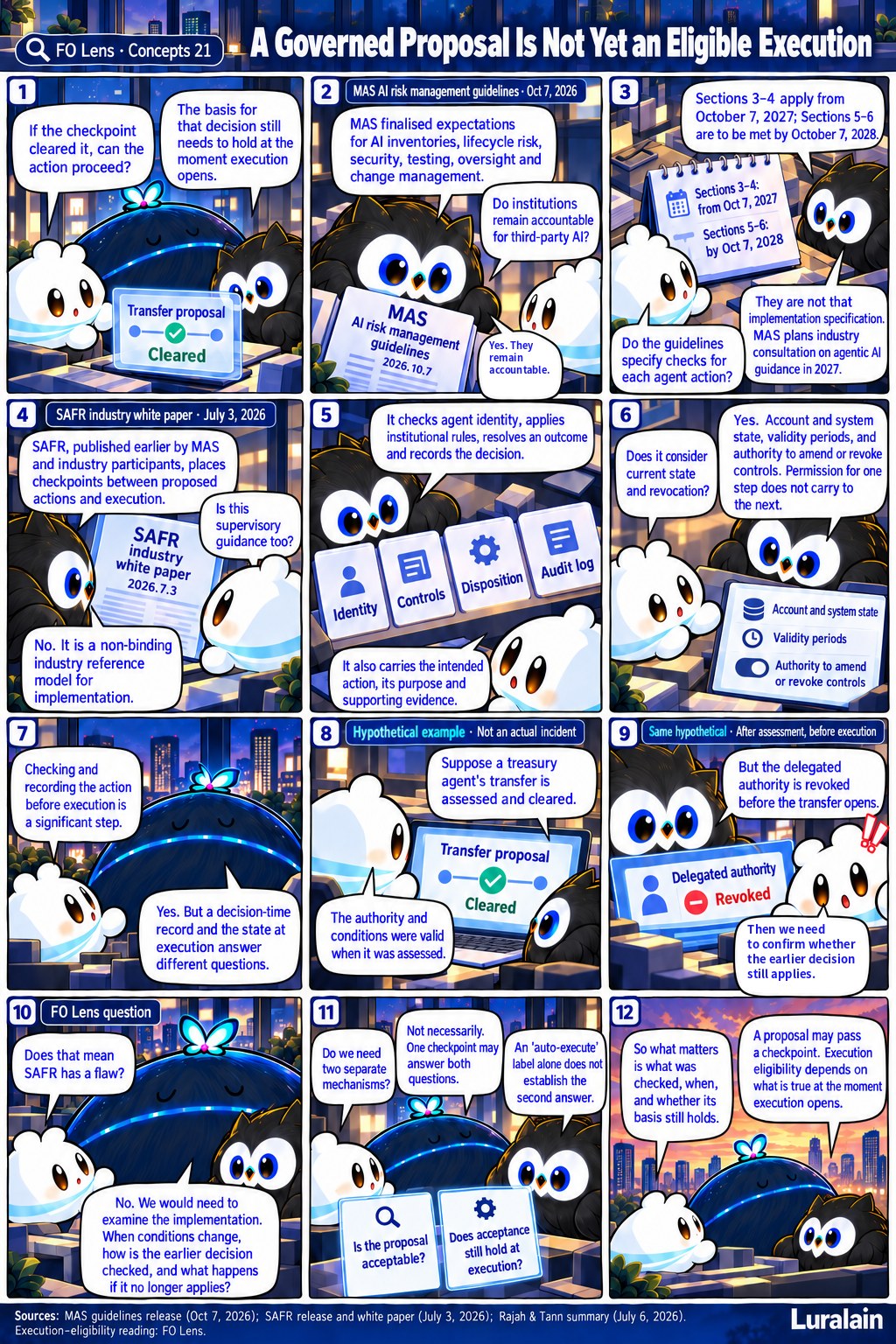
The same characters also star in a daily-life webtoon, Rurun Clocks In.