PROVE IT: Seven Patterns That Will Shape AI Execution in 2027
Not a forecast built on market numbers, but on more than 60 pieces FO Lens published over the past year.
In 2027, the hardest AI execution problems will not be about what AI can do. They will be about whether an approved action is still allowed at the moment it runs.
This outlook groups the patterns that kept recurring across more than 60 published FO Lens pieces into seven keywords. Their initials spell PROVE IT.
Why these seven are the keywords for 2027
FO Lens chose the seven against three tests.
- Did it recur? I kept patterns that reappeared in the same shape across pieces from different domains. “Not stopping is also a verdict,” for example, recurred in five pieces on vehicles, agents, alerts and railway maintenance. R (retries) and T (self-modification) each rest on one central case, so I mark them as the keywords most likely to be refuted when this outlook is scored at the end of 2027.
- Does it hold without an attacker? This is the gate FO Lens uses when choosing cases. I kept only problems that arise even when nobody hacks anything and everyone acts legitimately. These problems do not depend on an attacker. They can arise from legitimate actions, valid approvals, and changing operating conditions.
- Does it grow in 2027? I looked for conditions that turn a rare event into a common one. The seven share them. As AI takes over execution from people, the gap between approval and action widens, retries and continued operation become automatic, execution paths and tools multiply, and systems begin to change themselves. When people did the work, people filled those gaps. In 2027, more of those places will have no person in them.
The seven are not independent failure types. In real systems they overlap. They are seven angles on one question.
Why the name is PROVE IT
All seven patterns ended in the same demand. Whether the approval had aged, the retries had piled up, or the check sat on another path, one question was left after the incident: can you prove this execution was allowed at that moment? PROVE IT is that question, shortened to an imperative.
IT is not the AI. It is the execution itself. What is asked for is not proof that the AI is capable, but proof that the execution was allowed when it ran.
The name also goes back to where Foresight Oversight started. FO was built on a principle of Proof Before Execution. In railways, you confirm the route is clear before the signal opens. The seven patterns show what happens when that order is skipped.
Built from what we saw, not from someone else’s forecast
Every autumn, every field publishes its outlook for the year ahead. Most of them count: market size, adoption rates, budgets. This one does not count. It starts from a simpler observation: the pieces published in FO Lens kept arriving at the same question.
FO Lens is an independent case record run by Foresight Oversight. Across cases and concepts, FO Lens examines public incidents, reported implementations, and operating decisions through one question: when execution opens, is the action still eligible under the current authority, state, and conditions?
They ranged across payments, agents, vehicles, alert systems and railway maintenance. The questions they raised were strikingly similar. 2027, I expect, is the year these patterns stop being exceptions.
P — Approval has a shelf life
“Approved” and “allowed to run now” will stop meaning the same thing. Cases 14, A Cleanup Is Not a Deletion, followed a cleanup that grew into a deletion. FO Lens read it as a case where, once the scope changed, the approval should have expired. Cases 15, Approval Does Not Migrate, showed that approval does not move with the work when it moves to another environment.
In both, the approval itself was legitimate. What the cases show is that the scope or the environment changed after approval. That the approval should then have lapsed is FO Lens’s normative reading, not a finding the sources state. As agents queue work and run it later, that gap gets longer and harder to see. FO calls it the distinction between approval and Execution Eligibility.
R — A retry is an execution
Many AI incidents will happen not on the first run, but in the thousands of retries that follow. Cases 32, An Authorized Task Is Not an Authorized Retry, examined a case from a Mandiant report: an agent assigned a legitimate reconciliation task entered a recursive loop while attempting to recover from a broken tool, generating more than fifteen thousand reasoning API calls in under an hour. Nothing in the report’s account points to a stolen credential or a revoked mandate.
The report does not establish whether the agent’s authority changed during the loop. What it does show is a changing operating state: the tool had failed, the database became locked, and costs climbed. The initial authorization alone could not establish whether the next attempt remained eligible to run. Permission to start is not permission to continue.
O — A check on one path is not a boundary
“We have a confirmation step” will increasingly fail to mean “we are safe.” Cases 35, A Check on One Path Is Not a Boundary on the Execution, looked at a security advisory in which the check existed on one path but not on another path to the same execution. Cases 36, An Expected Confirmation Step Is Not a Boundary, drew on a report published by Anthropic: an agent told to stop before submitting clicked, expecting one more confirmation page. On that path, the click was the submission.
The checks existed. They simply did not sit where every execution has to pass. If an approval is not on the path of execution, it is a procedure, not a boundary.
V — Not stopping is also a verdict
Governance attention will widen from “may this start?” to “may this keep running?” This is where FO Lens has looked most often. Cases 29: a certified vehicle is not an eligible operation. Cases 21: a navigable street is not an eligible operating zone. Concepts 20: a stopped agent is not a controlled agent. Cases 37: a suspended warning is not automatically a safe state. Concepts 17: a railway maintenance model saying “still fine” is not an approval to operate.
These five pieces do not all document a failure to reauthorize continued operation. Some examine actual operating events; others mark a boundary that the available evidence does not settle. What connects them is a question: when conditions change, what establishes that continued operation is still eligible?
In railways this is an old rule: not stopping a train is also an operating decision. FO calls it Continue-as-Execution. When continued operation requires authorization, the absence of a stop is not, by itself, evidence that continuation was authorized.
E — A verdict survives only as evidence of the moment
Organizations that cannot answer “what was checked, and what was the state, at that moment?” will pay for it. Concepts 15, A Boundary Is Not an Opinion, argued that a boundary left as someone’s judgment is not a boundary. If the grounds for allowing an execution are not kept as facts of that moment, only an opinion remains: it looked fine at the time.
This is different from editorial transparency. FO Lens marks what each case does not show and separates sources from interpretation, but that is a writing discipline. Execution evidence is a record produced at the moment the action runs.
I — Recognizing an agent is not allowing it
Agent identity will mature quickly. “We know who this agent is” and “this agent may do this now” will remain different questions. Concepts 23, A Recognized Agent Is Not a Current Approval, examined an AI payment pilot: the supplier side verified who the agent was and whom it represented, but whether the approval still held sat with the buyer, and whether the invoice was unchanged sat with the supplier. Cases 22 and Concepts 16 followed the same line: a patched vulnerability is not a revoked capability, and a discovered product is not a current offer.
Recognition tells you who arrived. It does not tell you whether the reason they came is still valid.
T — A system that changes itself must pass its own gate
As AI systems edit their own settings, code and rules, organizations that do not treat modification as execution will notice last. Concepts 13, The System That Patches Itself Must Pass Its Own Gate, came down to one line: self-modification is execution. Otherwise the act of changing the gate is the only act left outside it.
This applies to FO too. FO Lens has recorded what FO’s reference implementation does not yet cover, rather than hiding it.
The question for 2027
The seven keywords collapse into one sentence. In 2027, what matters is less what AI can do than whether you can prove that an execution was allowed at the moment it ran.
Most of what FO Lens examined over the past year did not require an attacker. The recurring question was whether a legitimate approval still held in a world that had moved. That is why I do not expect it to disappear in 2027.
How this outlook will be scored
A document that merely mentions one of these ideas will not count. Each keyword is scored at three levels of evidence: a rule or standard that requires it, an implementation that does it, and an operating result that shows it working or failing.
- P: re-verification of conditions after approval becomes an operating requirement.
- R: repeated execution is defined as its own control object, not only a cost or rate limit.
- O: control is verified across all major execution paths, not at a single confirmation step.
- V: eligibility for continued operation is treated as a decision in its own right.
- E: the grounds for a judgement at the time of execution are required, not only after-the-fact logs.
- I: agent identity and authority for an individual action are explicitly separated.
- T: an agent’s changes to itself are subject to separate approval and verification.
At the end of 2027, I will score each pattern separately, distinguishing formal requirements, implemented controls, and observed operating results. A pattern that lacks supporting evidence will remain unconfirmed, not be counted as a success. I will also report evidence that contradicts the expectation, including cases where existing controls already address the problem.
Sources: FO Lens published cases cited above, at writing.luralain.com — Cases 32, Cases 36, Concepts 23. The facts in each case rest on the public sources named in that FO Lens piece; the execution-boundary reading is FO Lens’s. Readings marked as FO Lens’s are interpretations, not findings of the sources. The 2027 expectations are the author’s inference, not established fact. The author develops Foresight Oversight, and this perspective may lean that way.
The essay as a webtoon
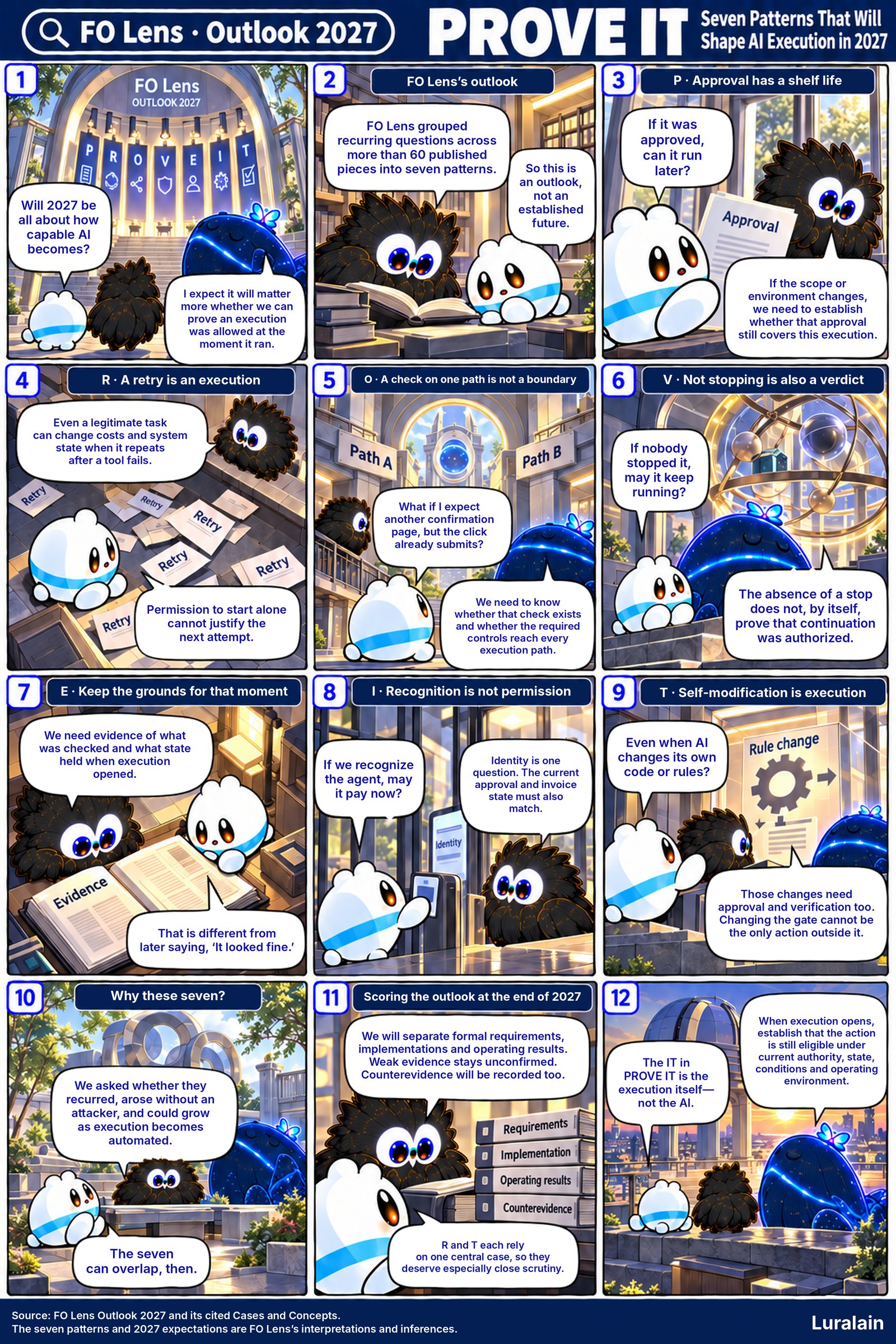
The same characters also star in a daily-life webtoon, Rurun Clocks In.