A Suspended Warning Is Not Automatically a Safe State
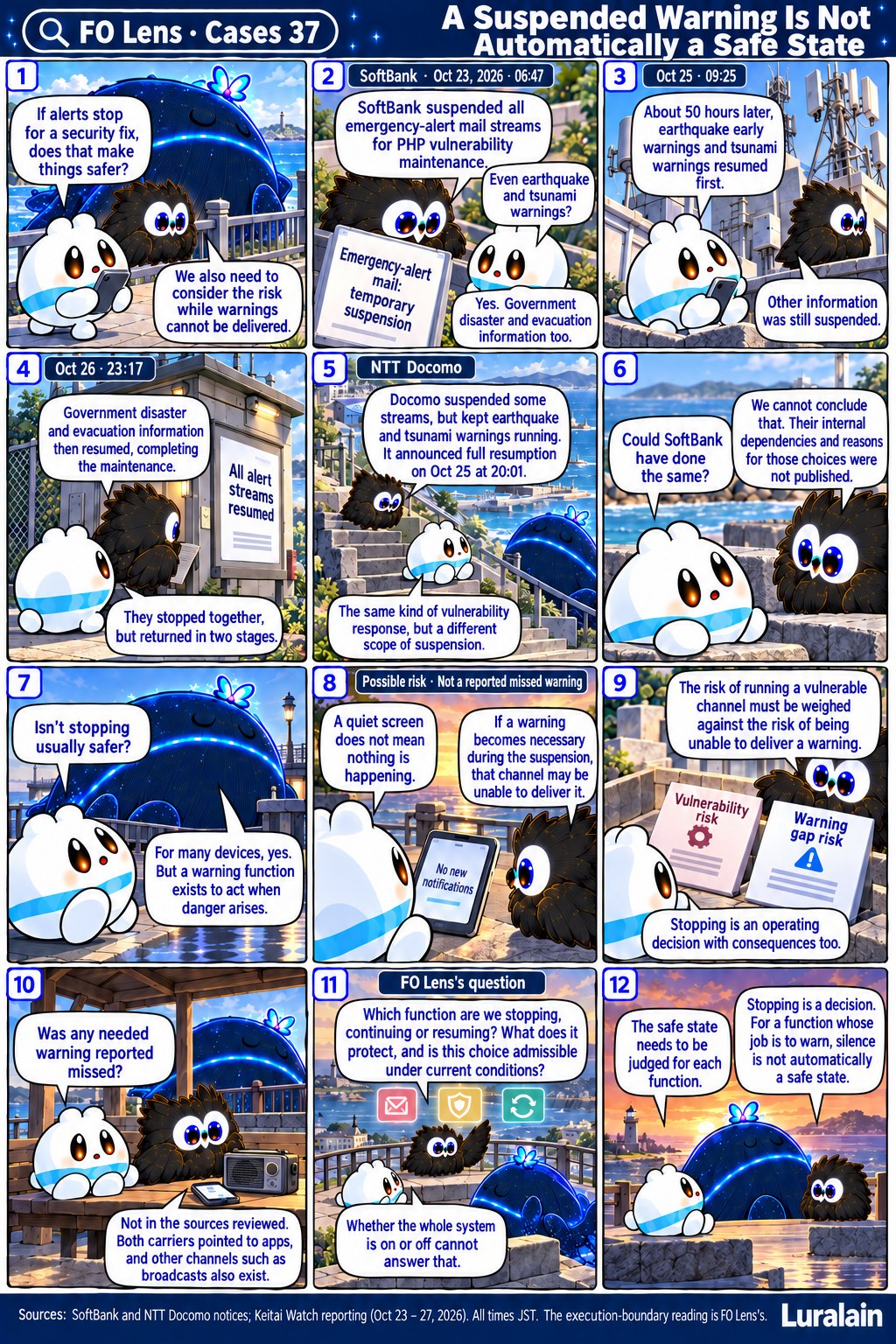
To patch a PHP vulnerability, a Japanese carrier stopped every stream in its emergency-alert mail service, then brought them back in stages. Another carrier, working on the same problem, kept earthquake and tsunami warnings running. The question is what the safe state was for each function, and who decided it.
What is reported
On October 23, 2026, at 6:47 a.m. JST, SoftBank began maintenance on the system that delivers emergency alert messages to phones on its SoftBank, Y!mobile and LINEMO brands, and stopped delivering those alerts. Its notice gives the reason as a response to a PHP vulnerability, and advised customers to use disaster apps in the meantime.
The suspension covered everything the service carries, including earthquake early warnings and tsunami warnings from the Japan Meteorological Agency, and disaster and evacuation information from national and local governments.
On October 25 at 9:25 a.m., SoftBank resumed earthquake early warnings and tsunami warnings. Government disaster and evacuation information stayed suspended. Contemporaneous reporting attributed the partial resumption to part of the maintenance work being complete. SoftBank’s notice does not explain why those two streams came back first. On October 26 at 11:17 p.m., the remaining alerts resumed and the maintenance ended, according to Keitai Watch.
NTT Docomo began work on the same kind of problem on the evening of October 23, describing it as a preventive response to a PHP vulnerability. According to Keitai Watch, Docomo suspended J-Alert messages, designated river-flood forecasts, local-government disaster and evacuation information, and a separate SMS alert service. Earthquake early warnings and tsunami warnings continued throughout. Docomo announced full resumption on October 25 at 8:01 p.m.
The usual reading
Read as a maintenance event, this is a carrier taking a system offline to fix a vulnerability, telling customers what is affected, pointing them to alternatives, and bringing service back as work completes. Stopping a system before patching it is the conservative choice. On that reading, the only questions are whether the outage was announced clearly and how long it lasted.
That reading is reasonable. This piece reads one assumption inside it: that stopping is the safe direction.
Which way is safe
In many systems, stopping is the safe state. A halted machine does not cut, a red signal does not let a train into an occupied block, a paused payment does not leave the account. Safety design in those systems is built so that failure falls toward stop.
An alert channel is different. Its purpose is to act when something happens in the world. When it stops, nothing visible fails. The failure appears only if an earthquake or tsunami occurs during the gap, and then it appears as a warning that never arrived. For this function, stopping is not automatically the safe state. It is a decision to accept a different risk: that a warning is needed while the channel cannot deliver it.
That does not make the stop wrong. A vulnerable component in the delivery path is a risk too, and the carrier is the party that can see both risks. The point is narrower: the decision to stop was an operating decision with its own consequences, not an absence of one. It needed the same question a decision to run would need: given current conditions, is this state admissible for this function?
The unit of the decision
The two carriers drew the line in different places.
SoftBank stopped every stream at once, and brought them back in two steps: earthquake and tsunami warnings after about fifty hours, government information after a little under four days. Docomo stopped some streams and kept earthquake and tsunami warnings running throughout.
Read together, the two notices show that the decision was not “is the system up or down.” It was made, or could be made, per alert stream. The maintenance status of a system is one fact. Whether a particular safety function may stop, keep running or resume is a separate judgment for each function, and the answer can differ while the system is in the same state.
What this does not show
This case does not show that SoftBank’s decision was wrong. Its notice does not say why all streams were stopped together, why earthquake and tsunami warnings came back first, or what the dependencies inside its delivery system are. The two carriers’ systems are different, and Docomo’s narrower suspension does not show that SoftBank could have done the same.
It does not show that any warning was missed. The sources reviewed for this piece do not report an alert that was needed and not delivered during the suspension.
It does not establish whether the vulnerability was exploited. Docomo describes its work as preventive. SoftBank’s notice describes a response to a vulnerability without saying more. Warnings also reach people through other channels, such as broadcast and apps, and both carriers pointed customers to apps.
Generalizing
Any operator of a safety function eventually has to take part of it offline: to patch, to upgrade, to contain an incident. The usual instinct is to treat the stop as the safe default and the restart as the decision that needs justifying.
For functions whose purpose is to act when the world changes — warnings, monitoring, protective interlocks, fraud alerts — the stop needs justifying too. The useful questions are the same for stopping, continuing and resuming: which function does this decision affect, what does that function protect against, and does the current state of the system support this choice for that function now?
Stopping is a decision. For a function whose job is to warn, a silent channel is not automatically the safe state; it is another risk someone has chosen to accept. That choice belongs to the function, not simply to the system as a whole.
Source note. This piece draws on SoftBank’s notice (更新)メンテナンスに伴う緊急速報メールの配信停止について (October 23, 2026, subsequently updated as service was restored), NTT Docomo’s notice on エリアメール (October 23–25, 2026). The list of streams Docomo suspended, its start time, and SoftBank’s full resumption time come from contemporaneous Keitai Watch reporting on Docomo’s partial suspension and SoftBank’s full resumption. Times are JST. Neither carrier has published the technical details of the vulnerability or the internal reasons for its choices. The execution-boundary reading is FO Lens’s.
The essay as a webtoon
The same characters also star in a daily-life webtoon, Rurun Clocks In.